Notice to Recover Possession: What Tenants Need to Know
When your landlord serves you a notice to recover possession at the end of your tenancy, what do you do? Do you pack and leave, fight…
Landlord & Tenant
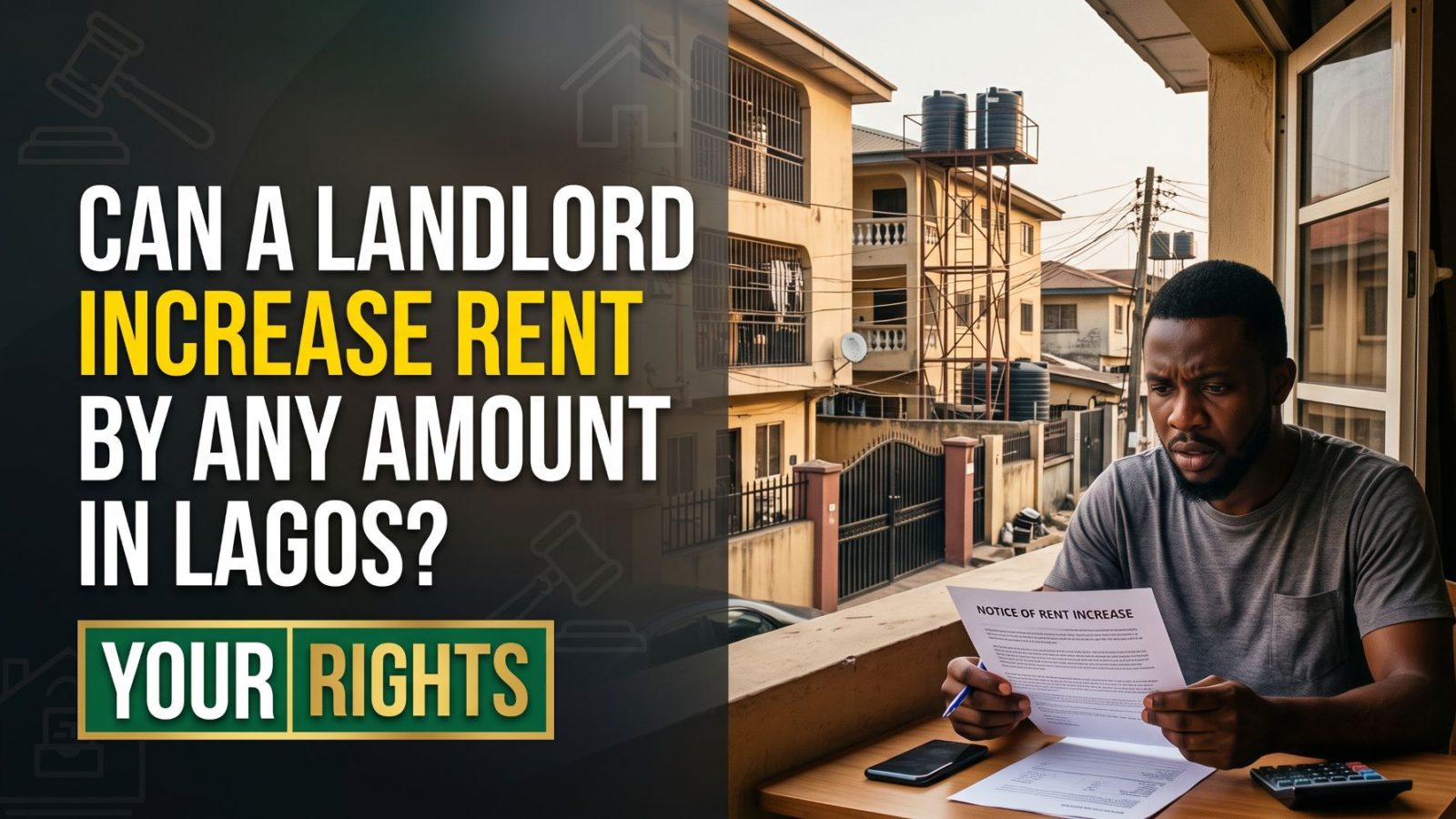
Can a landlord legally increase rent by any amount in Lagos?
This is the question most Lagosians are asking, including my neighbour, whose rent just went up from ₦1.5 million per year to ₦2.5 million. The dramatic increase in rent prices has made it hard for people whose salaries have stayed the same to keep up.
And it is not easy to reject the rent hike and move, as the situation is the same all over the state. Also, moving means dealing with higher agent fees, legal fees, moving expenses, painting, and other related charges.
This leads to an important legal question:
Is a landlord in Lagos legally entitled to increase rent by any amount they want?
The short answer is "not quite."
Under the Tenancy Law of Lagos State (TLLS) 2011, there is no prescribed general percentage limit for rent increases. The law does not say that a landlord can only increase rent by 10%, 20%, or 30%. What it permits is for tenants to challenge an increase they deem unreasonable, and the court can determine a specific rent (Section 37, TLLS).
So, essentially, the law does not simply say, "Landlords cannot increase rent."
Nor does it say: "A landlord can increase rent by any amount."
The legal position is more nuanced. But don't worry, we will break it down.
The first thing you need to know when faced with a tenancy dispute is the applicable law. In Lagos State, it is the Tenancy Law of Lagos State 2011, also referred to in the consolidated Laws of Lagos State as Cap. T1.
This law regulates matters affecting:
However, this law does not apply to all parts of Lagos. Section 1(3) excludes the following areas:
So, if you live in any of these areas, a different law applies to you. Therefore, while someone in Yaba, Surulere, or Egbeda can invoke Section 37, someone in Apapa, Victoria Island, Ikoyi, or Ikeja GRA cannot.
Yes, a landlord can increase your rent, but it matters when and how the increase was made. There are two things you need to pay attention to here:
Let's look at a situation where you sign a one-year tenancy at ₦2 million. You have paid the rent, and six months later, your landlord tells you that your rent is now ₦3 million because property values have increased.
In this case, your landlord has not legally changed the rent under the existing tenancy. But to determine the legality of the increase, you need to check your tenancy agreement. If the agreement fixes the rent for a particular term and does not have a rent review provision allowing the landlord to increase the rent during the tenancy term, the landlord cannot unilaterally rewrite the agreement.
On the flip side, if the tenancy agreement contains a rent review clause, things will be different. A standard rent review clause will state the period for a rent increase and the agreed method.
Therefore, when faced with an unreasonable rent hike, the first question is not how much the increase is, but what your tenancy agreement says about rent review and when it should take effect.
The second scenario is where you have paid rent, and towards the expiration of the tenancy, your landlord informs you of a rent increase. The language changes from,
"Your existing one-year tenancy, which you already paid for, has suddenly increased from ₦1.5 million to ₦3 million."
To:
"If you want to continue living here, the new rent is ₦3 million."
What this means is that the terms of the tenancy have changed. Since this is at the stage of renewal, you are dealing with a new tenancy agreement. But does this mean that an increase at this stage is beyond scrutiny and there's nothing you can do about it? The answer is no!
Your only legal recourse comes under Section 37, and as a Lagos resident researching rent increases, you must be familiar with this law.
Section 37(1) provides that, "Subject to any agreement to the contrary, an existing tenant may apply to the court for an order declaring that an increase in rent is unreasonable."
When your case gets to the court, the judge will consider these factors:
The court will look at the level of rents in the locality or a similar locality for comparative analysis. This means looking at what other landlords in your area are charging. So, if your landlord increases your rent from ₦1 million to ₦5 million, simply saying "that is what I want" does not necessarily end the legal inquiry.
For example, if you live in a two-bedroom flat and your landlord demands ₦5 million. You can provide evidence showing that other two-bedroom properties in the same locality are generally renting for ₦2 million–₦2.5 million.
However, the quality of the property matters when looking at rent. So, you cannot compare a newly renovated apartment with a generator, security, parking and other facilities with an old property without those features.
The court will look at special circumstances relating to the property and other relevant matters. This relates to the condition of the property, its location, facilities, and other relevant circumstances. All these are important in determining the legality of the rent increase, instead of looking at one figure in isolation.
Lastly, the court will look at the evidence provided by you and your landlord. The landlord will present evidence to justify the rent increase, while your evidence is to refute it. Therefore, once you receive notice of the rent increase, start documenting evidence.
You'll need the following:
Whether or not you've made up your mind to go to court, have these ready.
This is where Section 37 becomes more important, as the court is not limited to simply saying, "The landlord's increase is unreasonable."
Under Section 37(3), if the court is satisfied that the increase is unreasonable, it may order that the landlord change the rent to another lesser amount. Note that your landlord cannot eject you while your case filed under Section 37(4) is in court.
But this protection only applies if you have started legal proceedings. Therefore, simply complaining to your landlord does not mean that Section 37 proceedings have been commenced. This means that just because you sent a WhatsApp message saying you disagree with the rent does not give you protection.
Again, you must have a pending action in court to avoid getting evicted.
This is one of the most common situations tenants face. A landlord is not necessarily required to keep a tenant indefinitely at the old rent because the tenant cannot afford the new rent.
However, they must comply with the applicable tenancy agreement and the law governing recovery of possession. So your landlord cannot simply ask you to leave. If he wants to evict you, he must give you adequate notice as required by Section 13 of the Tenancy Law of Lagos State.
For a:
Also, issuing a quit notice does not give your landlord the right to throw you out. Under the law, your landlord cannot simply:
If your landlord does any of this, you can seek redress in court, and there are penalties under the law that you can seek.
Now, you might wonder what happens when you insist on paying your old rent and your landlord does not accept it. If you find yourself in such a situation, you are not without options.
Under Section 29 of the TLLS, if your landlord refuses to collect the current rent, you can apply to the court and pay the money into the Court's Registry. The law also provides for how the landlord can collect the rent and the amount to be deducted from it.
This is why a tenant faced with an increase in rent should not simply refuse to pay the rent and stay on the premises. Doing so will expose you to allegations of rent arrears, and the landlord can initiate recovery of premises proceedings against you.
Instead, if your landlord increases your rent to an unreasonable amount, seek legal advice immediately and understand your rights and options under the law.
It is evident that there is no current law stating how much landlords in Lagos can increase rent. Therefore, they are at liberty to do as they see fit. However, the rent increase must be deemed reasonable.
If you think your rent increase is unreasonable, speak with a lawyer and let them initiate a proceeding in court. At EverydayLegal, we can help you assess your case and proffer the best solution for your unique situation. Fill out our contact form, and we'll get back to you immediately.
This article is general information only and is not legal advice about your particular circumstances. Reading it does not create a lawyer-client relationship. If you need advice on your situation, tell us what's happening.
When your landlord serves you a notice to recover possession at the end of your tenancy, what do you do? Do you pack and leave, fight…
Whether you are a new graduate or have been working for a while, getting a job offer is always exciting. If it is your dream role…
Have you lent someone money, supplied goods to a customer, or completed a job, and the person you did it for is refusing to pay? If…
Tell us what's happening. We'll review your request and let you know the fee before any work begins.
Get Legal Help